Read this blog: The one where we discover about toe alignment
Sunday 8th March 2026
Today we planned to visit Polonnaruwa, Sri Lanka’s second capital city and another extensive ruined site.
The ancient capital at Anuradhapura was destroyed in 993 BCE by Chola invaders from southern India [now the state of Tamil Nadu] who ruled for about the next 75 years. In 1077 King Vijayabahu I, having commanded separate armies to attack Polonnaruwa on three fronts and besieged the city for seven months, eventually gained control and became king.
Polonnaruwa then became Sri Lanka’s second capital and continued in this capacity from the 11th to the 13th centuries.
King Vijayabahu I‘s grandson, King Parakramabahu I [1153 -1186], also known as Parakramabahu the Great, is celebrated in a 11 foot [3.4m] tall statue carved from a single block of granite and dating from the 12th century. Located near Pothgul Vihara, this was our first stop.
Pothgul Vihara means ‘Library Shrine’ and the site comprises both library and monastic remains.

There is some debate about what King Parakramabahu I is holding: a yoke for oxen or a leaf manuscript but he is certainly very simply dressed for a monarch.
King Parakramabahu I united the country and was passionate about agriculture, focussing on engineering and land husbandry to secure prosperity for the people. He is attributed with having said “Not even a drop of water that comes from the rain must flow into the ocean without being made useful to man“. He was an enlightened ruler, responsible not only for inaugurating temples but also for building hospitals, social welfare units, canals and large reservoirs and tanks. One such is the Parakrama Samudra reservoir covering 71km2, created by joining together five smaller reservoirs.
The vast monastic complex of Alahana Parivena was founded by King Parakramabhu on an existing cemetery ground and the name translates as Crematory Monastery. There are many small stupas on the site.
At the centre of this ancient city stands the Royal Palace Complex.
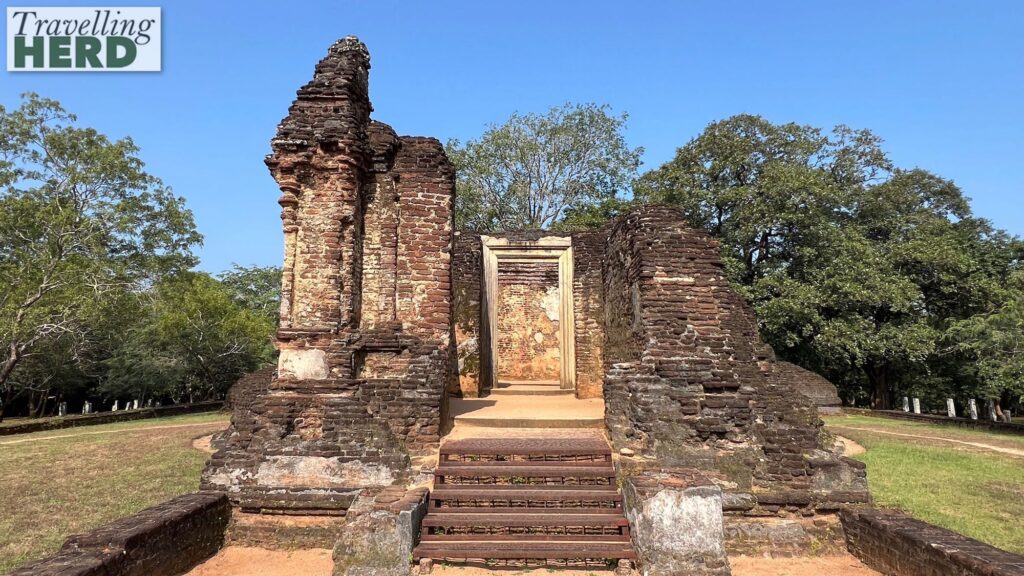
This contained King Parakramabahu’s Royal Palace itself, the Vejayanta Prasada, and the Council Chamber or Audience Hall and the Royal Baths as well as numerous other buildings. The Vejayanta Prasada is thought to have been seven storeys high with a thousand rooms. Even with just three storeys surviving, it is possible to imagine how grand and palatial this building would have been.
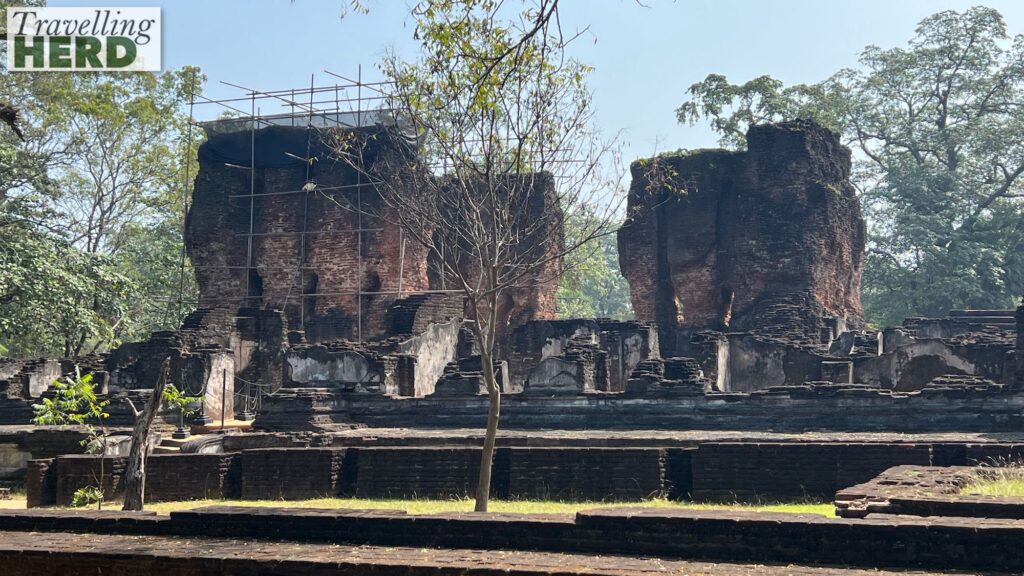
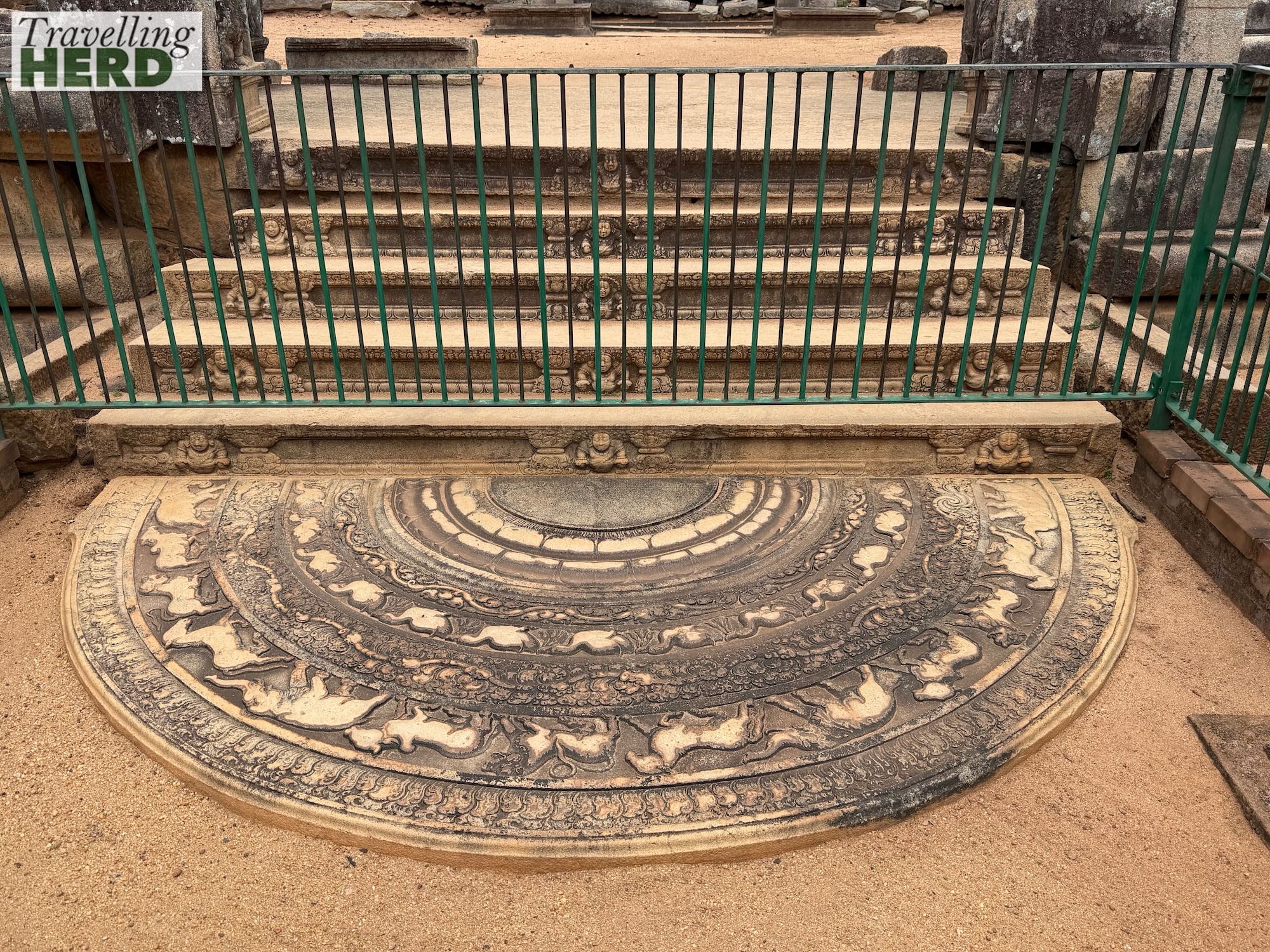
In the nearby Council Chamber or Audience Hall the King would have met with his courtiers and officials. The base is decorated with friezes depicting lions, elephants and dwarves. It features a fine carved moonstone at the entrance and balustrades. The sculptures flanking the top steps are described as lions.

Matilda felt they were more canine than leonine and could not resist giving one a pat.

We visited on a Sunday and there were many coach loads of Sri Lankans also visiting Polonnaruwa, some of which seemed to be school trips with parents.
With only a narrow bridge to access the Royal Baths there was quite a queue so our guide had taken us to see other interesting buildings first. When we returned there was little or no queue. The Royal Baths are an interesting geometrical structure but the water did not look very inviting.
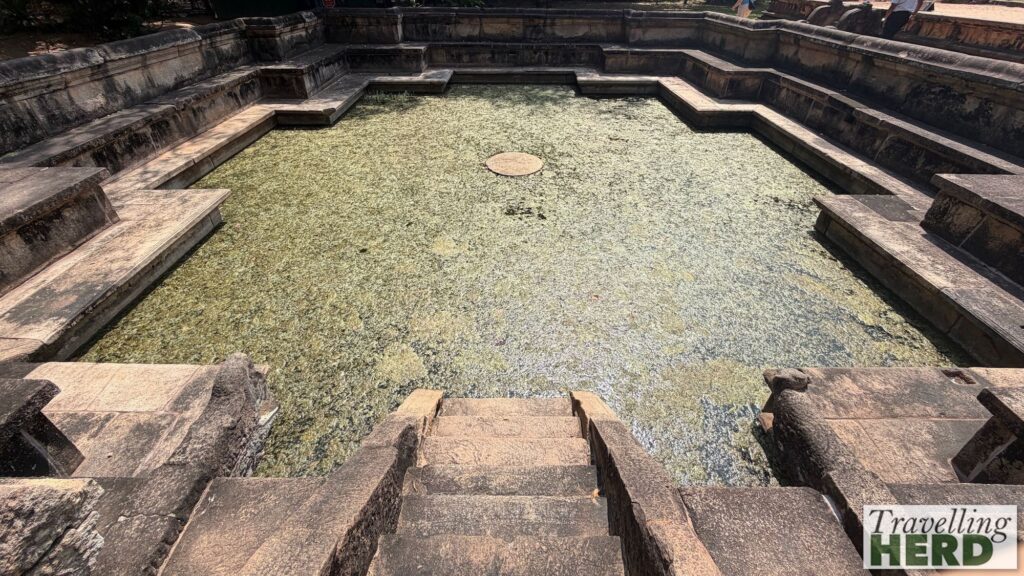
A short drive away, the Lotus Pond [Nelum Pokuna] is a charming stone bath built in descending tiers of eight petalled lotus flowers. We could imagine people sitting around the edges on different levels and chatting, chilling jacuzzi-style.

There are also buildings with a strong Hindu architectural influence within the ancient city ruins including the Thivanka Pilimage or Image House. Although this houses a Buddha statue, it is reminiscent of the temples and ruins at Siem Reap in Cambodia.

The name Thivanka derives from the fact that the statue is bent in three places: the knee, the waist and shoulder. These buildings would have been very dark without much natural light but the statues would often have semi-precious gems inlaid as their eyes and the windows would be positioned so that the light reflected off them.

The 12th century paintings on the walls of the shrine are comparatively well-preserved, and depict stories of the Buddha’s previous lives. They must have been truly beautiful and vibrant when they were first completed.

Gal Vihara [which translates as ‘Rock Monastery’] houses four large Buddha statues all carved from a single granite outcrop. The colossal sitting Buddha is 4.5 m [15 ft] high and sits on a low pedestal in a large rock niche.

Originally the four statues would have been housed within brick structures but now they are only protected by a canopy. The reclining Buddha measures more than 46 feet [14 meters] long, and is depicted at the moment of entering nirvana. Dilanka had explained that different poses indicate different stages of enlightenment. He told us that if the Buddha’s feet are completely aligned, then it is a resting pose; however, if one foot is slightly offset then the statue represents the moment of enlightenment at death.

For readers like us who remember the eighties with fondness, these statues appeared in Duran Duran’s Hungry Like the Wolf video.
Lankatilaka Vihara is one of the most iconic structures left remaining of the ancient kingdom of Polonnaruwa. The walls are 4m thick and 17m [five storeys] high creating a narrow aisle leading to an impressive statue of the Buddha, which even without the head [now sadly missing] stands at over 14m.

Robert can only tolerate so much culture and began to get tired of removing and replacing his foorwear and therefore both he and Dilanka kept their shoes on while Matilda went to walk round a stupa with beautiful metal Buddha statues.

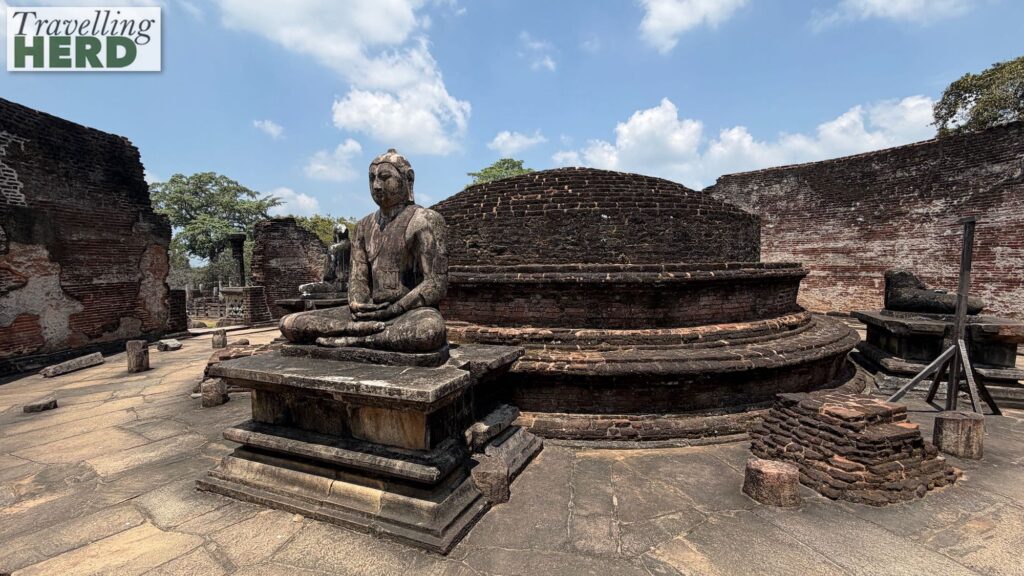
A vatadage is a circular relic house designed to protect a small stupa. It is thought that either Parakramabahu I built the Polonnaruwa Vatadage to hold the Tooth Relic or King Nissanka Malla built it to hold the alms bowl used by the Buddha. It is said to be the best preserved vatadage in Sri Lanka.

The Tooth Relic was a palladium of royalty in Sri Lanka, with possession conferring the right to rule. Successive monarchs moved the relic, building their own relic house to safeguard this sacred item and so it has had several homes.
The two stone platforms are elaborately carved. The lower platform has only one north facing entrance [pictured above] while the inner terrace has an entrance at each of the four points of the compass.
The Nisshanka Latha Mandapaya in Polonnaruwa was built in the twelfth century as a calm, reflective space for King Nissankamalla to listen to Buddhist monks chanting. It features distinct lotus-stalk-shaped pillars.
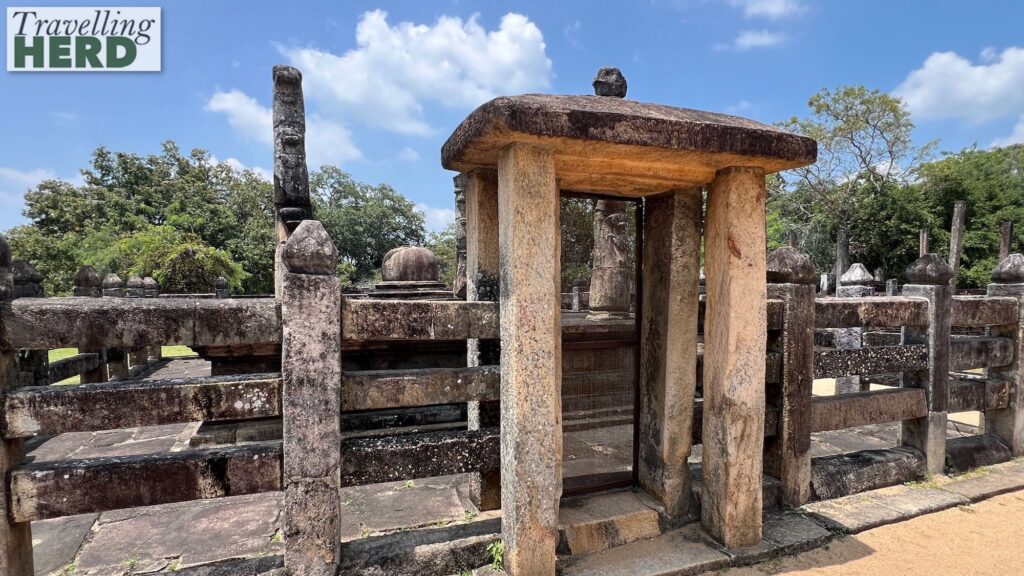
Medirigirya Vatadage is another circular relic house. A short drive from the main site and less frequented by tourists, we felt this was really impressive [see Selfie of the day]. The pillars would have supported a roof to protect the image.

It was a humbling experience to visit these ancient ruins. The product of such incredible power and influence and yet, it was abandoned in 1293 and swiftly reclaimed by the jungle to be rediscovered centuries later. Excavation work began in 1903.
Returning to our hotel, overlooking the Parakrama Samudra reservoir which had been conceived and built centuries ago, we appreciated the vision of this king who wanted his people to be self sufficient.
We also felt we had earned a cold beer.
Selfie of the day:

Dish of the day:

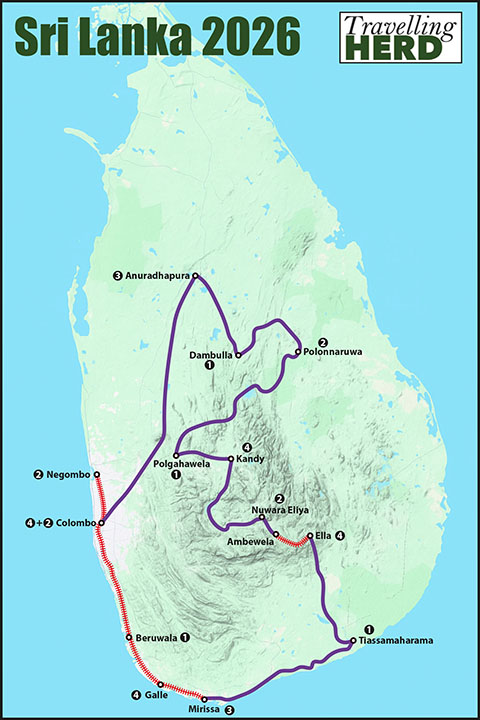
Route Map:
Discover more from TravellingHerd
Subscribe to get the latest posts sent to your email.