Read this blog: The one where we spot a Sri Lankan Leopard
Saturday 21st March 2026
There was torrential rain overnight so by the time the alarm went off at 04:30, neither of us had had much sleep but the best time to see the animals at Yala National Park is at dawn or dusk.
Yala National Park is vast, covering a protected area of 979km2 [about 378 square miles or 103,889 hectares] and is divided into five blocks. It is the second largest national park in the country after Wilpattu National Park which is approximately 1,317 km2.

Dilanka picked us up at 05:30 and drove us to meet our jeep safari driver/guide who in turn drove us to the ticket booth and paid for our entry. Although the sign read Ruhunu [Yala] National Park, it seems to be universally referred to as Yala National Park. Park Rangers checked the number of people in the jeep matched the number paid for on the ticket.

Apparently around 600 drivers are licensed to take jeep safaris into the park although not all are permitted to work at the same time. A further 150 have submitted applications for permits.
After a brief time queuing, at 06:12 we passed through the gate and entered the park.

We had a jeep to ourselves which meant we could choose where to sit and would be free to move from side to side of the jeep for the best view. The first sighting was of a herd of Ceylon Spotted Deer, also known as Sri Lankan Axis Deer. Sadly, they seem to be prey for many of the other species in the park.

Peacocks are very common in Sri Lanka and sadly we did become a bit blasé about seeing them.

The Sri Lankan leopard (Panthera pardus kotiya), is a sub species unique to this island. They are listed as threatened/endangered due largely to loss of habitat. The total population is estimated to be between 700 and 950 leopards. Yala National Park has the highest population of leopards per square kilometre but this equates to between thirty and fifty in the whole park. Although the website claims a ‘high leopard sighting success’ Dilanka, in a effort to manage our expectations, stressed that there was no guarantee and that he had been several times with clients who had not seen a leopard.
Safari guides and drivers obviously keep in touch and if there is a significant sighting this information is promptly shared. This ensures that everybody gets the chance to see a rare animal but also means that you may have to queue to do so. We spent maybe 20 to 30 minutes waiting in a line of jeeps. Rangers from the park came to manage the traffic queue. We were very lucky the day we visited: a leopard was resting in a tree close to the track. Even the rangers seemed to be turning up en masse to take a look. There were certainly more of them in attendance than were needed for traffic control.

Dilanka told us that this was the closest that he had ever been to a leopard.
They are the top predator in the ecosystem of the park. We did indeed feel blessed to have seen this fantastic feline resting and yawning [see feature photo] in the branches.
There are four distinct types of mongoose indigenous to Sri Lanka: this is most likely a Ruddy Mongoose or an Indian Grey Mongoose but we are not expert enough to be able to differentiate with certainty. As immortalised by Rudyard Kipling, a mongoose has lightning fast reflexes and a resistance to snake venom making them one of the few animals prepared to tangle with a cobra.

Our safari guide was excellent and pointed out many animals which we would have missed including this crocodile under overhanging foliage in a lake which we could easily have mistaken for a log.

A queue developed for a sight of this lone elephant walking through the park.

The jeep in front of us drove straight past this young Land Monitor resting in a tree. Apparently, the young ones often climb to escape predators and search for food but as they grow and get heavier they are more likely to be seen on the ground.

Dilanka had thoughtfully brought a copy of Birds of Sri Lanka with him so he could identify the species we saw. He looked this bird up and pronounced it to be a Lesser Adjutant – a type of stork which is the second largest bird found on the island and stands about 110 to 120 cm tall and has a wig span of just over two metres.

Usually solitary wading birds, we saw two close together.

Another jeep driver flashed his lights and told our driver of another significant sighting. We turned off the main track and were able to see a group of three elephants, including a very young one lying down [see below].

At the elephant orphanage we had previously learnt that elephants breastfeed for up to five years.
We felt quite sorry for this mother who was obviously still breastfeeding and was clearly also pregnant again.

Water Buffalo in Sri Lanka exist wild in the national parks and have also been domesticated for farming.They often submerge themselves in water and mud to help to control their body temperature.

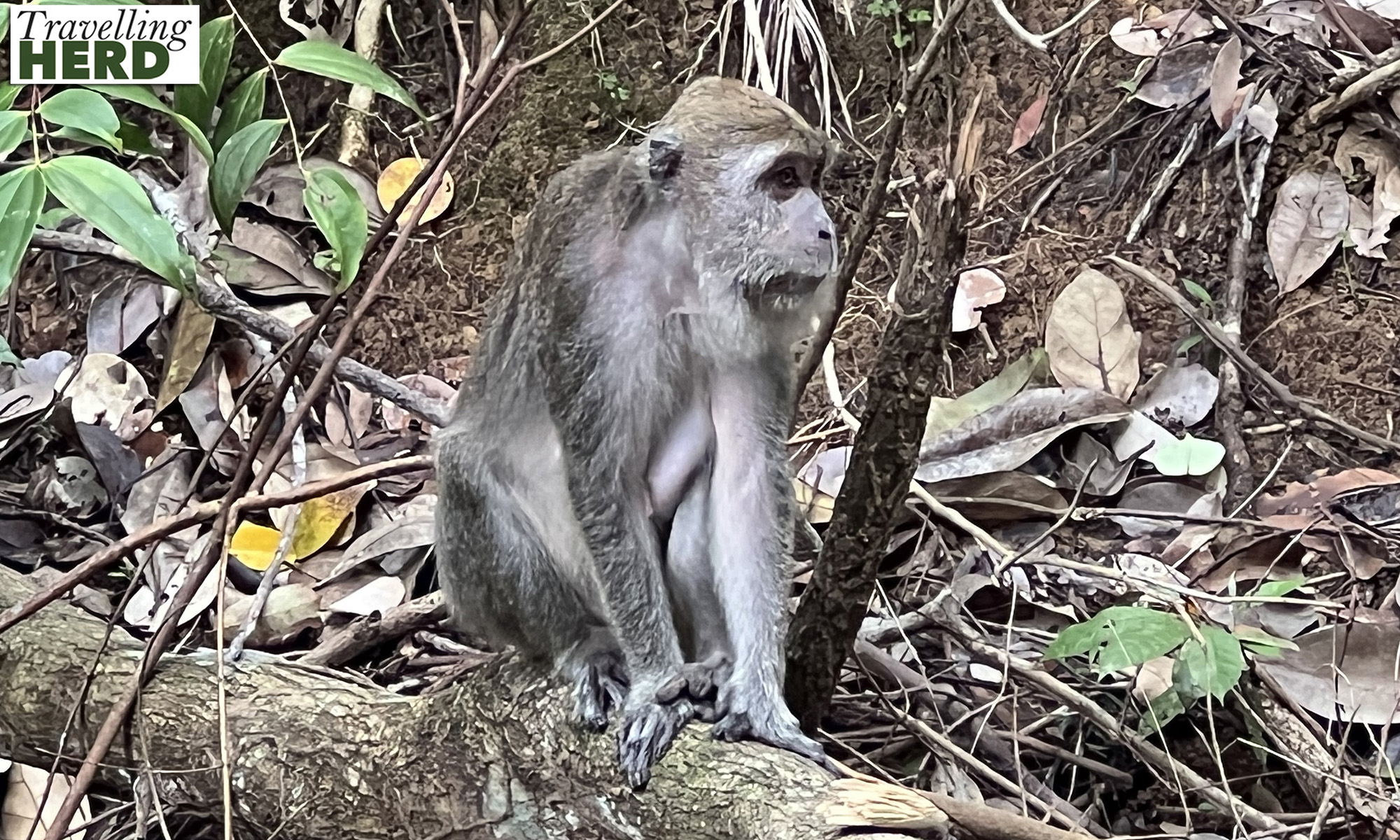
After we left the park we saw two jackals. Ironically, having seen monkeys in many of the places we have visited, we only saw one in the whole three hours we spent in Yala National Park.

We had agreed with the hotel that we could have breakfast when we returned from the jeep safari around eleven. We then packed up, checked out and set off for Mirissa. On the way we stopped at Kirinda Temple, also called Vihara Maha Devi Temple, with views over the sea. The site is associated with the second century BC legend of Princess Viharamahadevi who was cast adrift to appease the sea god and washed up safely near here.

The temple was used as a refuge during the 2004 tsunami, which heavily affected the region.

Dilanka also took us to Thissamaharama Temple. The large Bubble shaped stupa stands 186 feet tall with a circumference of 550 feet. It is said to house a left tooth relic and part of the forehead bone relic of the Buddha.
We noticed sacks looking like they might contain rice which people were leaving on the base of the stupa. Dilanka told us that people were buying and donating bags of paint so the stupa could be whitewashed twice a year.

Although Robert had decided that Matilda’s sarong was preferable to zipping and unzipping the removable legs on his trousers, he decreed that this would be his final temple on this trip.
We took the expressway to Mirissa and on the way were surprised to see that peacocks can be hazardous to motorists. Strangely the signs warning against peacocks were significantly larger than the ones we had seen alerting motorists to the likelihood of elephants crossing the road.

As we passed Mattala Rajapaksa International Airport (HRI) Dilanka told us that the airport was hardly used: apparently it is nicknamed the “world’s emptiest airport”. Located in a wildlife zone it has had so many bird strikes including incidents involving flocks of peacocks that by 2018 the major airlines stopped operations there.
Dilanka dropped us at Beach Mirissa Hotel, which proved to be a charming family-run hotel with a pool within easy reach of the beach.

We took a stroll down to the beach and found the Surf Shack which promised to serve us the coldest beer in Sri Lanka. Whilst this may have been somewhat of an overstatement as the beer warms up very quickly in these temperatures, the first sip was indeed cool and so refreshing [see Selfie of the day].

Video of the day:
Selfie of the day:

Dish of the day:

Route Map:


Discover more from TravellingHerd
Subscribe to get the latest posts sent to your email.