Read this blog: The one where we have breakfast with elephants
Tuesday 10th and Wednesday 11th March 2026
An adult elephant is obviously very strong and weighs between three and five tons. As we had breakfast we watched one of the new elephants break out of one of his chains. He was clearly unhappy or angry at being restrained. We both found it hard to watch as he flailed his feet and trunk in the water but we understood that the mahouts are experienced and know how best to manage the introduction of new animals to the herd. Hopefully he will be integrated soon. Once again it was reassuring that front of house staff made sure to talk to guests to explain the situation.
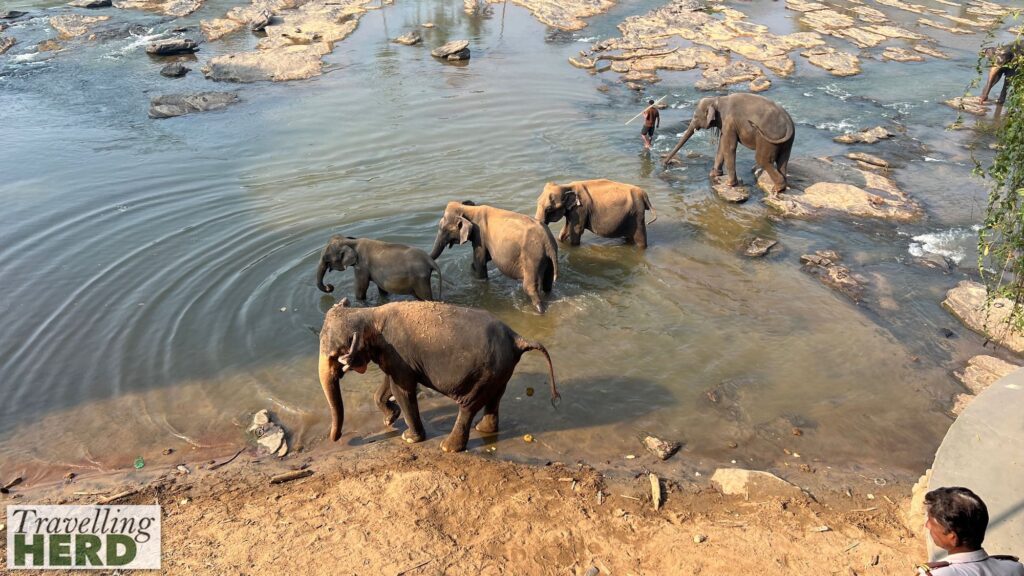
As the waiter had assured us the night before, egg hoppers were indeed available for breakfast. These are a traditional dish which we had been wanting to sample. They are made by swirling slightly sweet batter [made from fermented rice flour and coconut milk] around a curved pan then, once this is sufficiently set, breaking an egg into the pancake shell, mixing it up slightly and covering it all with a lid while it cooks. The chef recommended sweet chutney to go with them. Matilda also sneakily added a sausage to hers. Fold them over to eat. They were delicious and we enjoyed them all the more as we had a view of some elephants bathing as we ate [see Video of the day].

Dilanka picked us up from the hotel and drove us to Kandy. He had warned us that the traffic was bad there. This is partly because it is a large city and partly because it is surrounded by hills and routes in and out are therefore limited by the terrain.
After we had checked in we watched monkeys strolling nonchalantly along the railings on our balcony [see also Selfie of the day].
A sign on the patio doors warned us against leaving anything valuable outside.
Some were just passing through and others seemed to want to rest awhile. We think the one at the top of the picture above was pregnant.

As we were staying several nights, our first priority was to organise getting our laundry to housekeeping. On longer trips like this we aim to travel light with about ten days’ worth of clothes, planning to have them washed every now and then when are staying long enough in one place for the hotel to get them washed, dried and returned to us. There was only one [relatively small] laundry bag left in the room and Robert had to go to reception to ask for more.
Once the items had been counted, the form had been completed and two bags handed in at reception we were ready to go and take a stroll round Kandy.
Matilda had been expecting somewhere more rural but Kandy is in fact a major city said to be the cultural capital of Sri Lanka.
Robert navigated us to The Pub and we sat on the first floor balcony and watched the world go by. We also decided to eat here [see Dish of the day].

The following morning we decided we would first visit the sites within walking distance of our hotel. Although this was the longer route, Robert decided we would walk anticlockwise round Kandy Lake along the southern shore as this provides the best views of Ulpange or the Queens’ Bath and the Temple of the Tooth Relic.
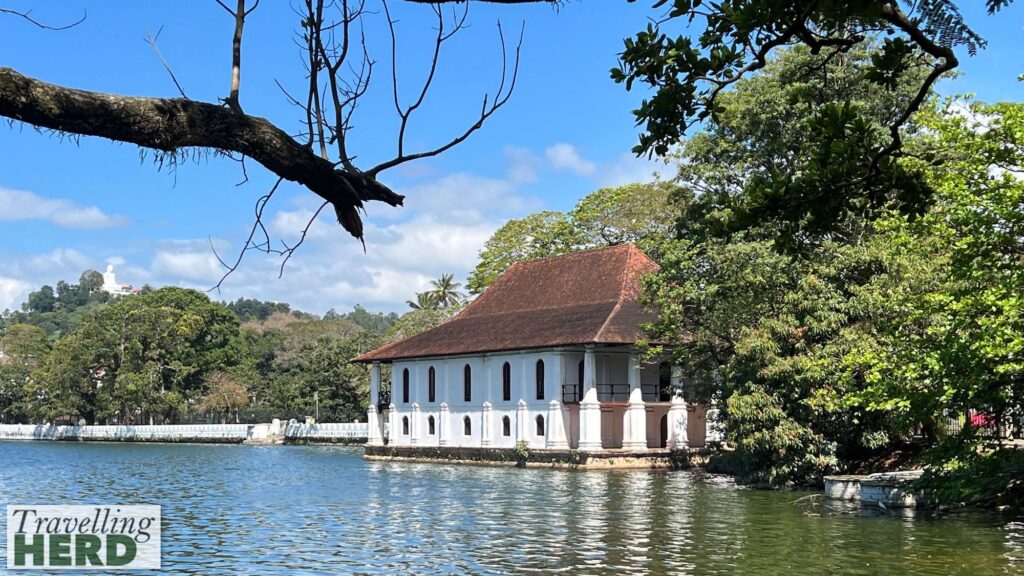
Kandy Lake or Kiri Muhuda which means ‘Sea of Milk’ was created by King Sri Wickrama Rajasinghe [1798 – 1815 CE] the last monarch of the Kandyan Kingdom. He used an island in the centre as his pleasure house before the British converted it into an ammunitions store.
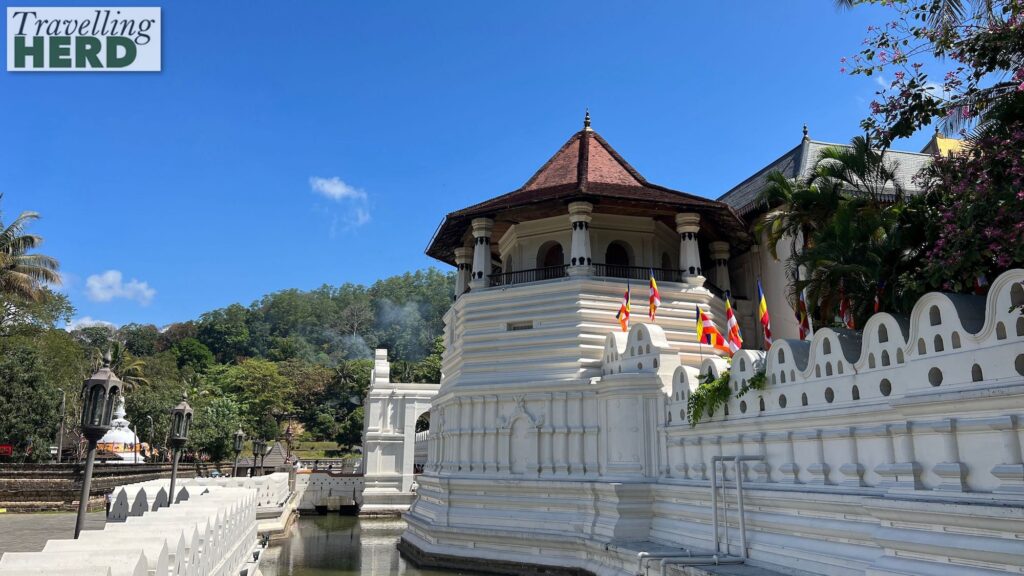
As mentioned in an earlier blog, the Buddha’s Tooth Relic was the palladium of royalty and successive kings built their own relic house to safeguard this sacred item and symbol of their power. The final resting place of the left canine tooth of the Buddha is therefore here in Kandy, where the last of the Sinhalese monarchy placed it for safekeeping. It is still kept in one of Kandy’s most famous buildings – Sri Dalada Maligawa – the Temple of the Sacred Tooth Relic.
The Octagonal Tower [below] contains many books and documents.
We paid our entry fee and left our shoes. Almost no photography is permitted within the various shrines and buildings within Sri Dalada Maligawa.

We were initially uncertain whether, as foreigners, we should queue, but as other Europeans were, we decided to join the line waiting to be able to walk past the reliquary containing the tooth. People were being hurried along and a monk inside the area where the reliquary was kept was rather robustly telling people not to linger. As we are not Buddhist we were not emotionally invested but other people in the queue had offerings and we felt sorry for the very brief time they were allowed to stay. Considering the size of a male human canine, the reliquary is huge.
Photography is permitted in the Alut Maligawa where a series of paintings tell the story of the journey of the Tooth Relic.

We also queued and visited various shrines including the Pallemale Viharaya, the Paththiripuwa, the Raja Tusker Museum and the Kandy Palace Museum which had been the King’s main residence before British colonial rule.

The treaty ceding power to the British was signed in the Audience Hall [above] in 1815.
The Raja Tusker Museum in the complex now houses the preserved body of the elephant named Raja who carried the Tooth Relic casket for 50 years. A tusker is an elephant with long prominent tusks. Not all Asian elephants have tusks and apparently, with the rise of ivory poaching, the tuskless gene is becoming more prevalent. Although the taxidermist was undoubtedly skilful, Matilda subscribes to the term ‘laying to rest’ and felt it was a poor reward to be displayed in this way after years of service.

The golden roof over the main shrine was added in the 1980s.
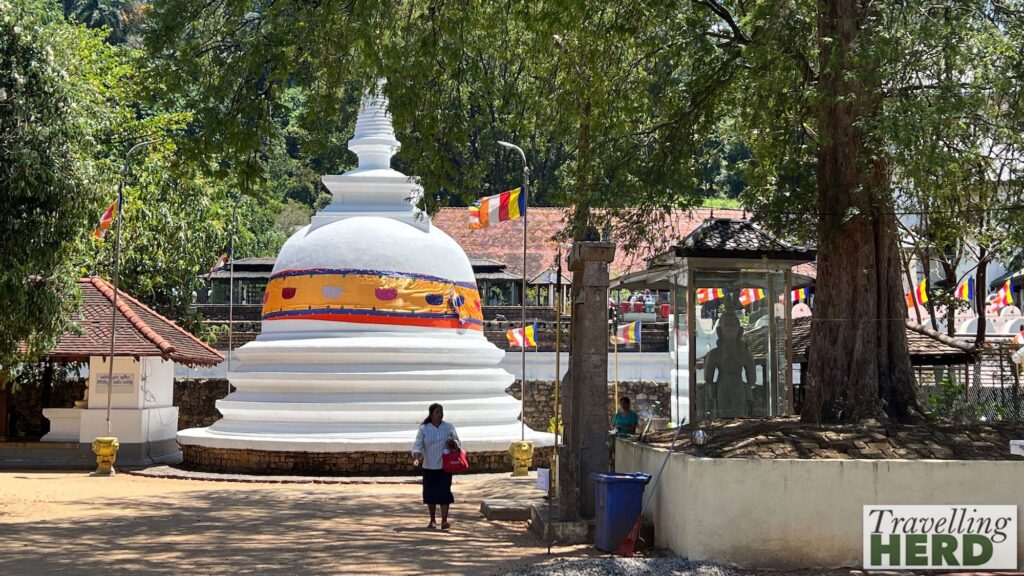
Nearby is the brick built St Paul’s Church completed in 1852. Visitors are asked not to photographs inside for security reasons so we duly complied.

Ulpange or the Queens’ Bath was used by the queens and concubines of King Sri Wickrama Rajasinghe [1798 – 1815 CE] the last monarch of the Kandyan Kingdom. Before the bath house was built, water for bathing was drawn from a nearby spring, giving rise to the name Ulpange which means ‘Spring House’.

Kandy Lake was originally a paddy field called Thigolwela. The bath house was initially a single storey building, but the British added another floor.

We used PickMe to order a tuk tuk to take us up to the Sri Maha Bodhi Viharaya Temple and the Bahirawakanda Vihara Buddha. We were glad we had not decided to walk as even the tuk tuk seemed to be struggling with the incline.
At 88 feet [25 metres] this is one of Sri Lanka’s tallest Buddhas. The temple was built in 1972 and the statue of Buddha was completed in 1992
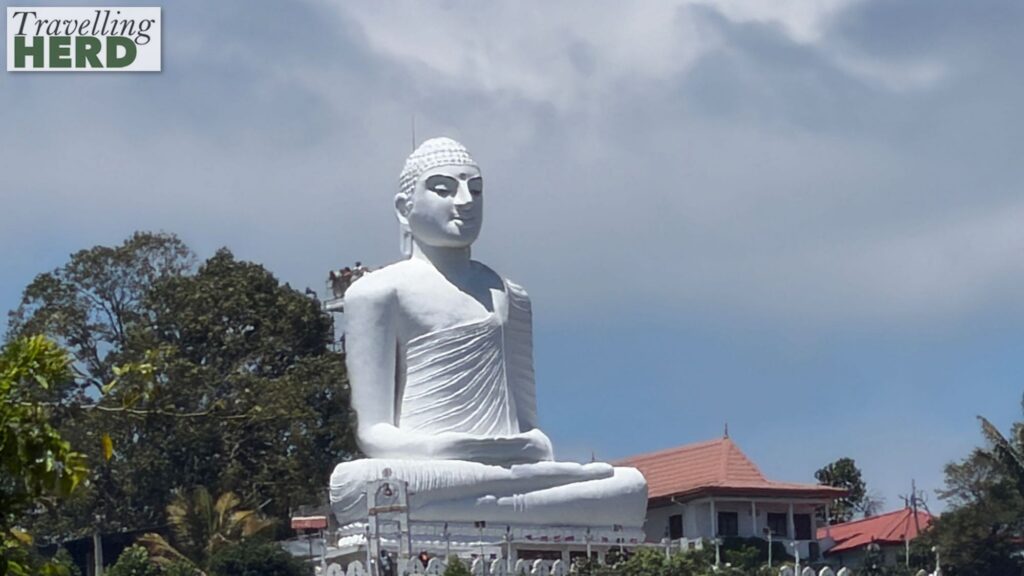
Steps behind the statue lead to a platform offering panoramic views of the city of Kandy . . .
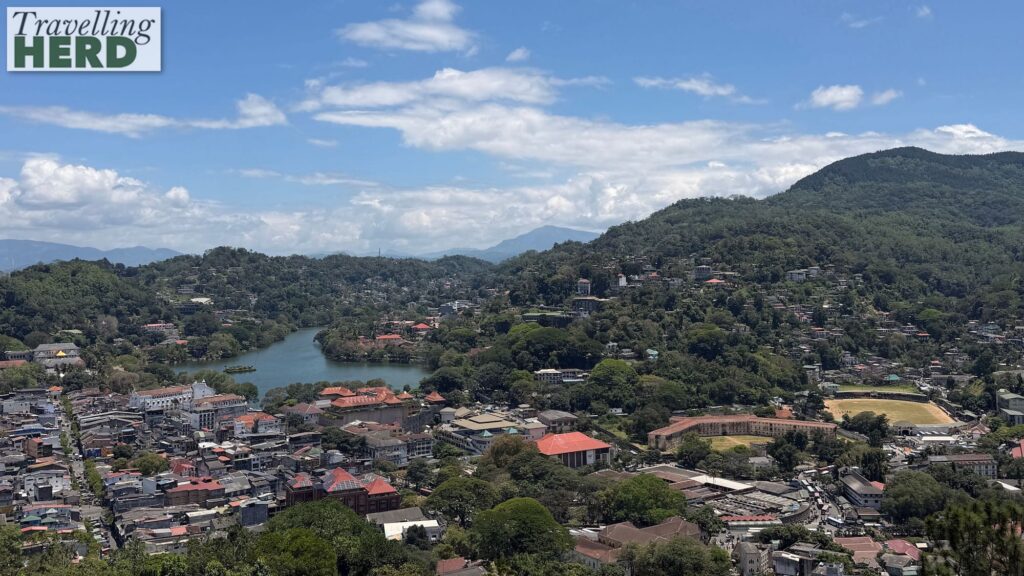
. . . and surrounding hills.

A gentleman in the Office for Donations beckoned Robert in and proceeded to chant while he wrapped a white string bracelet round Robert’s right wrist. This is called a pirith nul or blessing thread and represents protection, health and good fortune and is intended to protect the wearer from danger and negative energy. As we are both wearing woven leather insect repellent bracelets, Robert is now beginning to look like a bit of a hippy, much to Matilda’s amusement.
The gentleman then predicted that Robert would live until the age of 94. His father is 95 and his mother will turn 90 this year so it could be in the genes.
Matilda had read the name of the office and was wary about the level of donation which might be required so declined to enter. So perhaps she was suffering from negative energy after all. As both her parents died in their early 70s, she is not so keen to have her longevity predicted.

The return journey by tuk tuk predictably cost us more than we had paid to get there but it was a seller’s market and we knew we did not want to walk down. We asked to be dropped at the Queen’s Hotel for a refreshing drink.
Originally built by the Kandyan King for Dullewe Adigar, one of the chiefs of the kingdom, it was then adapted to be the Governor’s residence under British Colonial rule. It was also used to house troops for a period before being turned into a hotel.

While not as grand nor as well-cared for as some of the old colonial style establishments we have visited, we did have a very refreshing drink at the Queen’s Hotel and Robert pronounced his glass of Lion to be the coldest beer he had been served on this trip.

Later we returned to The Pub for a quiet drink. The starlings had other ideas. Matilda was convinced that the collective noun for starlings was a murmuration and they were definitely not murmuring. However, a little research provided us with the information that there is more than one collective noun depending on the situation. A chattering of starlings is used to describe their noisy, communal roosting behaviour, whilst a murmuration refers to a vast swirling flock in flight.
We were also treated to a passing marching band.
Video of the day:
Selfie of the day:

Dish of the day:

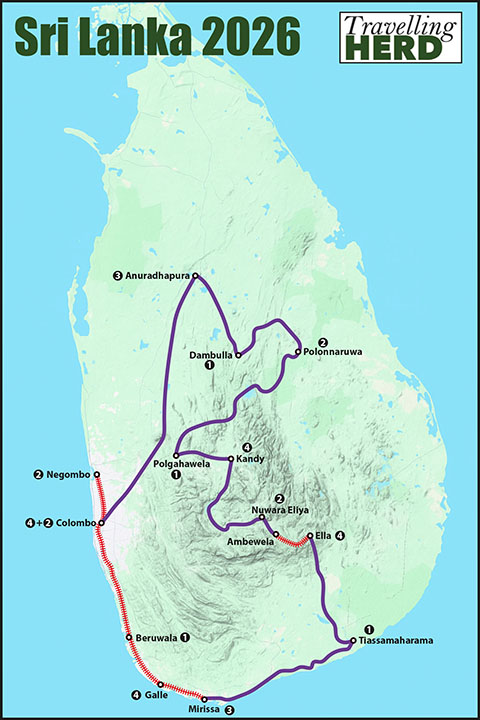
Route Map:
Discover more from TravellingHerd
Subscribe to get the latest posts sent to your email.