Read this blog: The one where we are talked into a three course meal
Monday 9th March 2026
Today we had a date with pachyderms so we knew we needed to leave our hotel promptly. Breakfast service started at 07:00 and we were downstairs in the restaurant right on time. We had been forewarned that it would be an a la carte service rather than a buffet. This was not explicitly stated but we assumed, with so few guests due to the events in the Middle East, that this was a sensible decision intended to save wastage.
We also assumed, mistakenly as it turned out, that with only a few people to cater for, the service would be swift and efficient. Despite allowing 30 minutes for breakfast and checkout we were slightly delayed and left just shortly after time we had planned.
Returning along a route we had already travelled we saw the same elephant in almost exactly the same place and once again stopped to admire him.
Dilanka suggested a slight detour off our route to visit the Nalanda Gedige said to be the centre of Sri Lanka. As Robert is fond of telling people that Solihull, where he grew up and spent his formative early years, is the historic centre of England we felt we should also visit the centre point of Sri Lanka.

As the locations of these sites were calculated centuries ago we do feel there is a potential margin of error in both cases.
From here we went to the Ranweli Spice Garden. There may have been some confusion about Robert’s intended destination as he had expected to go to the National Spice Garden of Sri Lanka at Matale.
The visit was nevertheless informative. Our guide was obviously very knowledgeable and gave us a huge amount of information very quickly about the various plants, herbs and spices growing in the garden as well as their medicinal, therapeutic and culinary uses.

He also gave each of us a “tourist” massage designed to alleviate stress and tightness caused by looking upwards at the impressive sights of Sri Lanka.
This business is obviously run as a well-oiled machine. After a tour of the plants we were each offered a further massage – Robert went for a back massage and, as she had been experiencing the odd twinge when climbing thousands of steps, Matilda opted for a knee massage. Although we were told this was ‘free’, it is obviously customary to tip the masseurs. We were also treated to an explanation of the Ranweli Spice Garden’s range of products – oils, teas, powders, tablets – and the benefits to be derived from taking/using them.
Matilda was tempted to buy some cinnamon for our daughter who loves the flavour but the thought of carrying it round and trying to keep it in a presentable condition put her off.
Robert had previously received an email notification that check-in time at the Hotel Elephant Park, Pinnawala was 16:00, after the end of the daily bathing time at the Pinnawala Elephant Orphanage. He was also told that, although our room would not be available, we could pay US$8 each for early access to the hotel and this would allow us to go down to the river bank and watch.
This is obviously also an income generating scheme but it is in a good cause and we naturally opted to pay the money. People who are not staying locally can also pay [a higher price] for an elephant bathing experience.
We arrived at the Hotel Elephant Park, Pinnawala, at 13:30 in good time to deposit our bags with reception and watch the 14:00 elephant bathing session. This hotel is not directly associated with the orphanage but the location is perfect and the staff are very knowledgeable. Also the view is second to none.

Pinnawala Elephant Orphanage is separated from the Maha Oya River, by a thoroughfare and so the elephants are brought across the road and down the street by the side of our hotel twice a day to enjoy time to cool off in the water.
Matilda was told that the young elephants, in particular, are curious and was advised where to stand to maximise the chance of one trying to interact with her. The advice was sound. As the elephants walked past, the three youngest all reached out with their trunks looking for contact which she was happy to provide. On the other side of the road, one of the older elephants stopped right next to Robert.

We had a fine view from the restaurant over the Maha Oya [which translates as Great River] where the elephants are brought to bathe and the staff obviously reserved the best riverside seats for residents as we were assigned a table with a view before our room was available.

One elephant seemed entirely focussed on submersion, lying in the water and raising the tip of its trunk above the water level to breathe from time to time – just visible in the photo below.
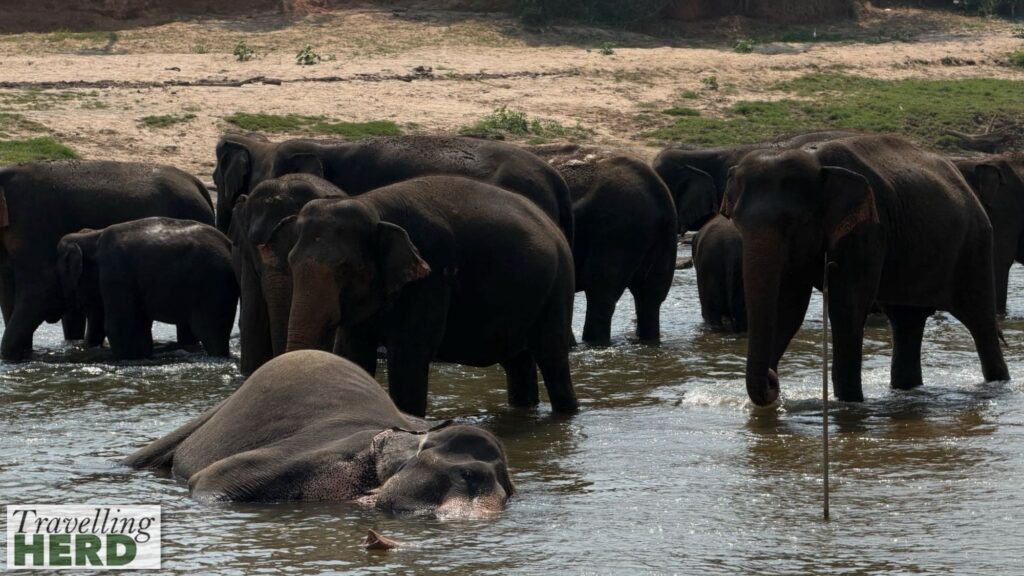
The Pinnawala Elephant Orphanage was founded in 1975 by the Sri Lanka Department of Wildlife Conservation to care for and protect the many orphaned and sometimes unweaned wild elephants found. Elephants can breastfeed for anything between two to five years.

The Pinnawala Elephant Orphanage is now a conservation and breeding institute which claims to have the largest herd of captive elephants in the world. In 2023, the herd of 71 elephants, comprised 30 males and 41 females spanning three generations.

We were initially dismayed to see that some of the elephants had been chained to metal hoops driven in to rocks in the river to prevent them from straying too far. None of the elephants that walked down the street to the river were chained or manacled, however. The mahouts also had sticks with small hooks on the end and the elephants were obviously very conscious of the need to avoid these.
The front of house staff at the hotel were very mindful that guests might be disturbed by this and made an effort to talk to everyone to explain that the elephants which were chained had only recently been rescued and come to the Pinnawala Elephant Orphanage. They therefore needed a phased and controlled introduction to the rest of the herd. The chains were the equivalent of a lead for a dog, to ensure the animal’s safety, and they would soon be able to join the group unshackled.
On 31 August 2021, a 25 year old elephant named Surangi gave birth to make twins at the orphanage: the first time this has happened in captivity in Sri Lanka since 1941. We believe this is one of the twins.

People who had paid for an elephant bathing experience were encouraged into the river with the elephants. It seemed to be predominantly those in bikinis who were being photographed lying on top of these majestic animals. Whilst we appreciate that this generates income to support the conservation work of the orphanage, it did seem as though the elephants were not being given the respect they deserve. Matilda was asked if she wanted to go into the water and a combination of neither wanting to exploit these magnificent animals nor wanting to get into water with a significant amount of elephant poop prevented her.

The hotel pool overlooks the elephant bathing area but we felt we had a better view from the restaurant.
We had really enjoyed walking with elephants last year in Laos, and despite our initial reservations, it was incredible to see a semi wild herd of this size, interacting with each other.
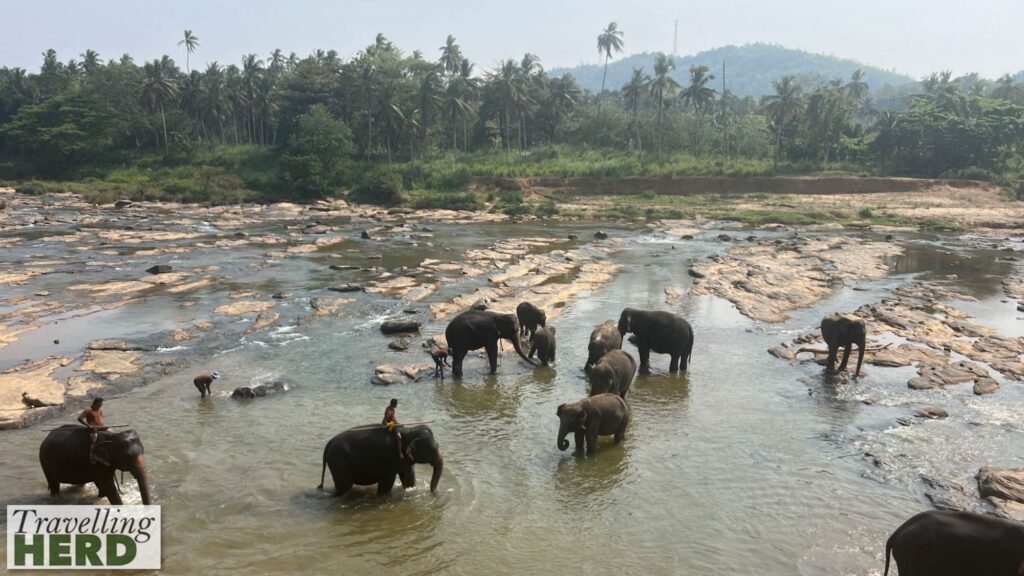
The younger elephants seemed vey curious and keen to interact with the new additions to the herd.

We noticed that some of the elephants have pink spots almost like freckles on their forehead ears and trunk. This is due to a natural loss of pigmentation associated with ageing.

It must seem like trying to manage a group of four ton toddlers: after bathing in the river, as soon as they were clean, the elephants scooped up mud from the river bank with their trunks and covered their backs with it to provide protection from the sun [see Video of the day].
We were also told to watch out for the bats at twilight.
Our evening meal was included ordered from a set menu. The waiter provided us with some useful hints. He advised against ordering the egg hoppers as these would be available at breakfast. He also advised against ordering prawns because of the distance we were from the sea. Unusually, he also persuaded us both to have a starter and a pudding [see Dish of the day].
Video of the day:
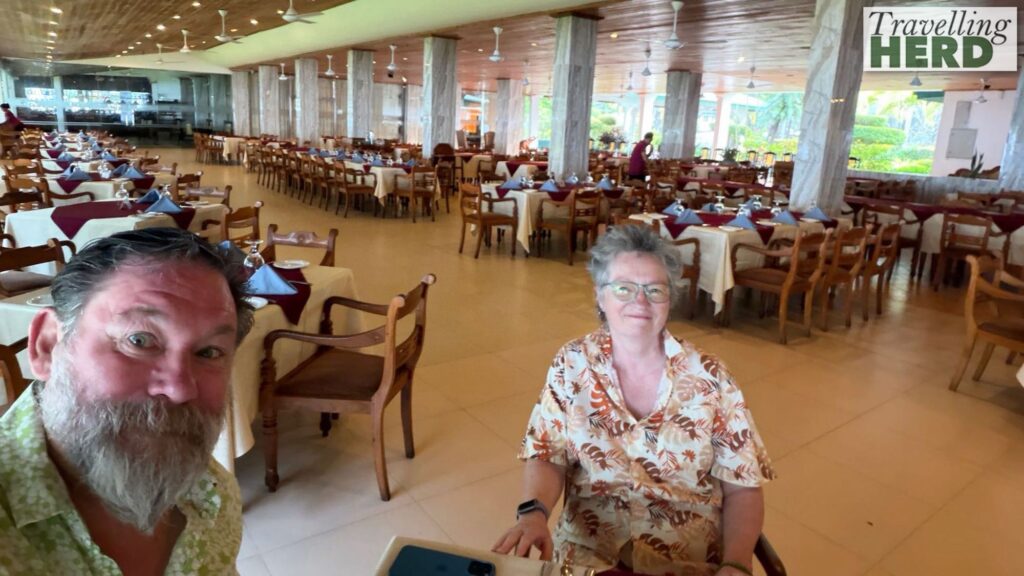
Selfie of the day:

Dish of the day:

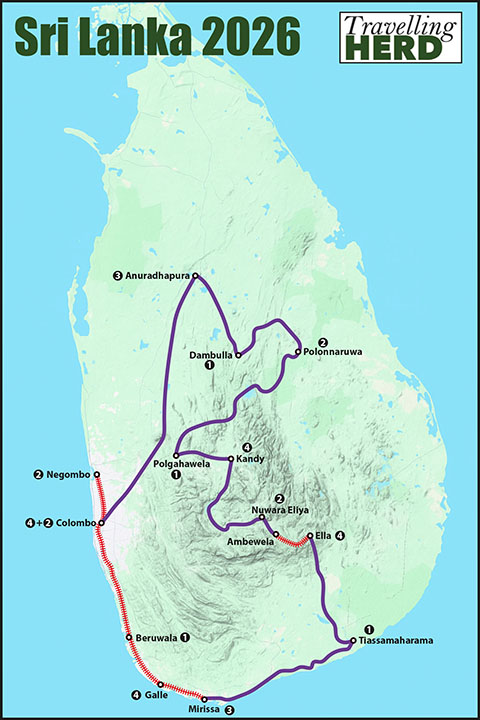
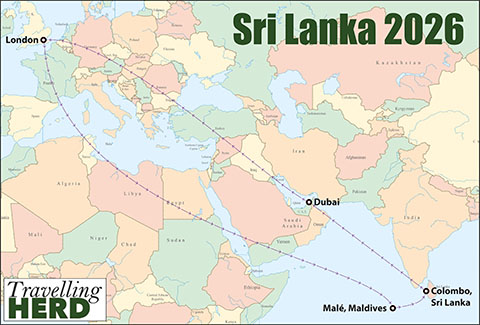
Route Map:
Discover more from TravellingHerd
Subscribe to get the latest posts sent to your email.