Read this blog: The one where Robert has a communication from aliens
Wednesday, 4th March 2026
We woke up to find that it was rather overcast and were quite pleased as we felt that this would make the day cooler for our planned sightseeing. Anuradhapura was founded in 377BC by King Pandukabhaya and was the religious and political heart of the kingdom for over 1300 years until 993AD making it Sri Lanka’s first and longest serving capital. This UNESCO World Heritage site covers 40 km² and we saw only a fraction of this in our five hours of sightseeing. Thankfully Dilanka drove us between the major sites.
There are the remains of three great monasteries within the historic site of the ancient city at Anuradhapura: Mahavihara, Abhayagiri, and Jetavanarama. These monasteries were the centres of Theravada, Mahayana, and Vajrayana Buddhism, respectively.
The Mahavihara monastery is the oldest and most prestigious of the three and we went there first. Within the complex stands the Ruwanweliseya Stupa, also known as the Great Stupa. It is said to contain the largest amount of the Buddha’s remains held in one place, variously described as one eighth of his relics or two quarts [four pints or half a gallon]. We are slightly uncomfortable with quantifying his remains in this way.
The stupa is surrounded by a sand walk or sand paved terrace for circumambulation: an act of devotion when pilgrims walk barefoot in a clockwise direction on the hot sand as a sign of respect.
Within the sand walk and closer to the stupa is the stone paved terrace which gets even hotter in the scorching sun. Our guide advised us to wear two pairs of socks to avoid burning our feet, but as the day was overcast the stone floors were not as hot as we had anticipated.

Around the boundary wall hundreds of elephants stand guard, representing strength and protection for the stupa. Most of the elephants have been renovated/replaced but in one section the original wall has been retained, protected by a canopy.

Rather shockingly, the Victoria & Albert Museum Order an Object service has a photograph from the 1890s of the elephant wall, looking like those on the right, which states that the tusks were originally real ivory.

Buddhists, many wearing white and coming to make offerings, far outnumbered tourists [see Selfie of the day] when we visited and we watched a procession circumambulating round the stupa.
Our guide, Dilanka, told us that there are three different species of monkey in Sri Lanka: the Toque Macaque, the Grey Langur and the Purple-faced Langur. At this site we saw the Purple-faced Langur.

The Jaya Sri Maha Bodhi is a Ficus religiosa or Sacred Fig tree which is believed to have been grown from a cutting from the original tree in India under which Buddha attained enlightenment. Unfortunately, the original tree has not survived. The sacred cutting, however, is on the left and still thriving if in need of a little support.

Thuparama Dagoba [Thuparamaya] is the first documented Buddhist temple in Sri Lanka dating back to the introduction of Buddhism to the island by Mahinda Thera. Although it is one of the smallest, because of its heritage it is also considered to be one of the most important.
Pillars lean drunkenly around the site: they would originally have supported a sloping roof. These were added by King Aggabodhi II almost 800 years after it was first constructed Believed to have been built around 247BC much of what is visible now is the result of reconstruction work in 1862.

Jetavanaramaya or the Jetavanarama Stupa in the Jetavana Monastery Complex was built by King Mahasena of Anuradhapura [273–301 AD] and at 122m [400 ft] it was the world’s tallest stupa, and the fourth tallest structure in the ancient world after the two great pyramids and the Lighthouse at Alexandria. It is said to contain a belt connected to the Buddha.
Time and renovations have reduced it to 70m [230 ft] but it is still thought to be the largest structure built entirely out of brick: approximately 93.3 million baked bricks were used in its construction.

Dilanka then took us to the Jetavana Museum which Matilda was pleased to find had pleasant restrooms as well as artefacts from the ancient site. Nearby there was a brick-built circular well with a flight of stone steps descending to the water. It is thought this keyhole shaped well was probably used to supply water for the rituals of the nearby Bodhi-tree Shrine.

Robert went to take a photo of the pond near the museum and Dilanka told us he would show us even better ones.

True to his word he took us to the Kuttam Pokuna which means twin ponds/pools. These ancient bathing tanks form part of the Abhayagiri Vihāra complex. They demonstrate how advanced the ancient Sinhalese were in terms of architecture and managing water resources. The smaller north pond is said to be older than its larger companion to the south.

Many monkeys had congregated here, perhaps to be close to the water or perhaps to charm tourists who might be a source of food.

The Samadhi Buddha is a famous statue situated at Mahamevnāwa Park in Anuradhapura, Sri Lanka. This statue is seven feet three inches high and carved from dolomite marble. It is thought that it was originally gilded with inlaid eyes made from precious gems and that it was one of four statues placed around a sacred Bodhi tree shrine.

Abhayagiri Dagaba is almost a smaller version of the Jetavanarama Stupa, and is said to be where the Sacred Tooth transported to Sri Lanka was first kept. It is also said to house a footprint.

The Refectory or Alms Hall in the Abhayagiri Complex includes huge stone troughs which were used to hold food for serving the communal meals. It is large enough to provide a serving of rice for each of the 5,000 monks who lived here.

Next stop was Elephant Pond, also known as Eth Pokuna which was constructed about 1,500 years ago. It measures 159 meters in length, 52.7 meters across, and 9.5 meters deep with a holding capacity of 75,000 cubic meters of water, hence the name.

The entrance to a stupa or temple of worship traditionally had a semi-circular carved stone at the foot of the steps known as a ‘moonstone’. The example found at the Mahasena Palace is particularly fine [see feature photo]. Interpretations vary, but the outside ring is often seen as flames with the animals in the concentric inner rings representing the various phases of man’s journey through the cycle of rebirth.
Temple or stupa entrances also featured stone dragons with carved tongues forming the balustrades for the stairs and guard-stones [or murugala] to support the balustrades. Initially plain, these became increasingly ornate with intricate carvings representing protection and strength. The guard-stones [or murugala] from the entrance to the Isurumuniya Rock Temple are said to be one of the best examples of this art form in Sri Lanka. One is preserved in the museum and one is on display.

The Isurumuniya Rock Temple is of a very different style. Believed to have been built by King Devanampiyatissa about 300 BC instead of vast stupas, the temple is carved out of, and around, a natural rock formation with a pond at the entrance.

The elephant carving at the water’s edge dates from the seventh century BC. As we left, we saw bats roosting in a crevasse [see Video of the day].

Ranmasu Uyana Park contains the ancient Magul Uyana [Royal Gardens]. Also referred to as the ‘Royal Goldfish Park’ it is situated close to Isurumuniya Temple and was a pleasure garden for royalty.
It features several bathing ponds with areas which may have been changing rooms concealed behind waterfalls and demonstrates the sophistication of the ancient Sinhalese hydraulic engineering.

In Ranmasu Uyana [Golden Fish Park] low on the rock face is an ancient carving, which is said to be a chart to unlock the secrets of the universe. Measuring about 1.8m in diameter, it is called Chakraya [which translates to “Universe Cycle” in Sinhalese]. The tuk tuk driver who told us about it in Colombo certainly believed it was a gateway to other planets and civilisations.
On the other hand, Robert thought the aliens in another universe were telling him it was time for a cold beer.

Video of the day:
Selfie of the day:

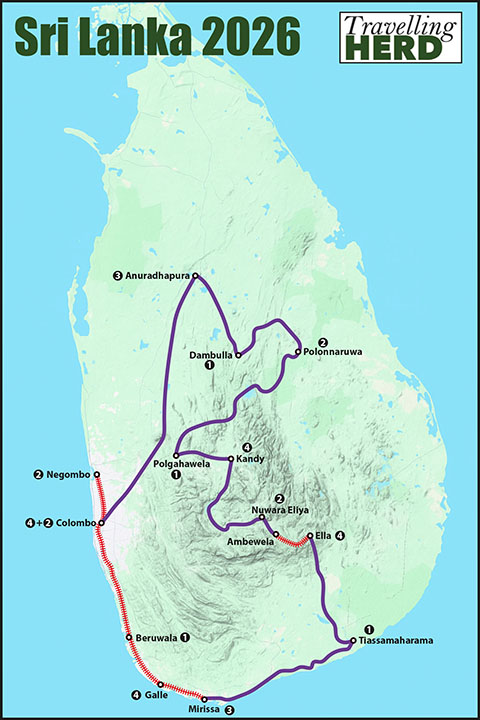
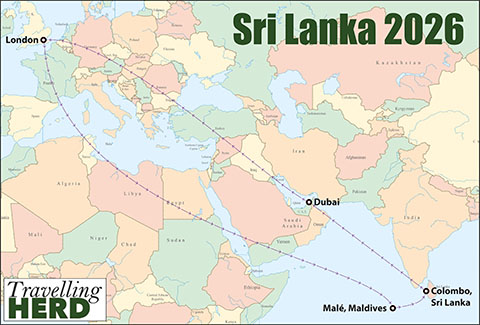
Route Map:
Discover more from TravellingHerd
Subscribe to get the latest posts sent to your email.